Extension Springs and Safety Cables in Oceanside
How stretch springs lift older Oceanside garages, and why a bare coil is a risk worth fixing.
Extension springs stretch along the horizontal tracks to raise the door, instead of twisting on a shaft the way torsion springs do. Oceanside still has them in some smaller single-car garages, especially in Townsite and Loma Alta, and safety cables through the coils are the part most often missing.
How the Stretch Lifts the Door
An extension spring runs along the top of each horizontal track in an Oceanside garage, and it lifts by stretching rather than twisting. As the door drops, the spring pulls out longer and stores force for the next opening. Two springs work independently, one per track, so a door can still limp partway open on a single working spring after the other fails, which is often the first clue something inside the track is wrong.
Each spring sits on a stationary pulley bolted at the rear of the horizontal track. A lift cable rides that pulley forward, then turns down at the front of the track and clips into the bottom bracket with an S-hook. Raising the door stretches both springs along their rails; closing lets them relax. Nothing rotates on a shaft, so the whole assembly has to fit inside the same track that carries the rollers.
Watch the door open and the difference is obvious. A torsion spring barely moves; it twists in place on its shaft while a drum winds the cable. An extension spring does the opposite — the whole coil stretches and shortens along the track as the door travels, pulling on a pulley near the top corner. That visible stretch is the working stroke. On older Oceanside garages in Townsite and Loma Alta, it's the fastest way to tell which system is behind the panel.
What the Cable Backs Up
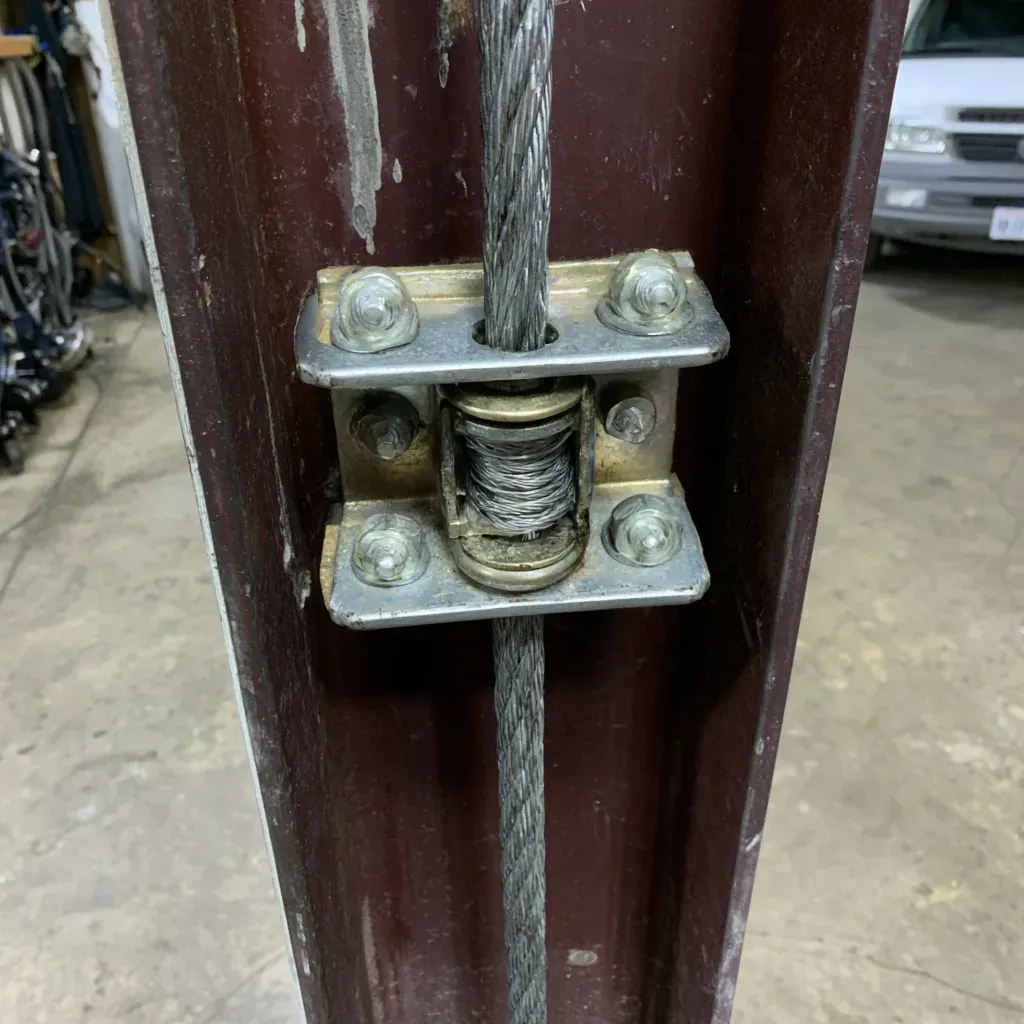
The safety cable is a separate strand routed inside each extension spring's coils, bolted top and bottom on its own, apart from the spring. If a coil snaps, that cable keeps the broken pieces from whipping loose over the car or a workbench below. Older Fire Mountain and San Luis Rey garages built before this hardware was standard sometimes run bare springs. Any pro doing a broken spring replacement on one of these should treat missing cables as a repair, not an option to skip.
A snapped extension spring is not a fluke. The coil sits stretched near its working limit through every open-close cycle, season after season, and coastal humidity works on the steel the whole time. Eventually a coil fatigues or a hook wears through, and the spring parts. Oceanside's salt-tinged air along routes like Coast Highway speeds that fatigue on hardware that already runs stressed by design.
A spring that lets go without a cable in place has somewhere to go. The stretched coil carries stored energy, and once it separates, that energy throws loose metal along the same path the door travels, not simply dropping it. A properly anchored safety cable keeps the pieces contained near the bracket instead. Garages in older sections of Oceanside built before this hardware was standard practice are the ones most likely to be running without one now.
Living With Extension Springs
A torsion spring rusting on its shaft tends to announce itself first, a door that feels heavier over several weeks or a loud crack from directly overhead. Extension springs skip that warning. The coil is already carrying near-maximum stretch on every cycle, so the last trip before failure looks the same as the thousand before it, then the door simply will not lift or drops partway with no buildup a homeowner would have caught.
Extension setups also carry hardware a torsion shaft has no use for. The pulley wheel wears a groove into its own bracket after enough passes and can bind. The S-hook joining spring to cable flexes with every cycle and eventually opens or fatigues at the bend. None of that exists on a torsion system, where a single shaft and a stationary bearing plate do the same job with far fewer places to wear.
Weighing a Torsion Swap
Trading extension hardware for torsion means removing the tracked springs, the pulleys, and the S-hooks and installing a single shaft mounted above the header, centered over the opening. Headroom is what settles whether it can happen. Smaller single-car garages around Townsite and Loma Alta, built in an era before torsion became the default, often leave only a few inches above the track, and that gap has to fit the new shaft, its drum, and its mounting brackets.
Given enough clearance, the shaft takes over the job the stretched coils were doing, holding tension while sitting still instead of lengthening with every cycle. Gone are the pulley, the S-hooks, and the exposed spring stretched along the track in view of anyone in the garage. What is left is fewer moving parts and less hardware for coastal air to work on. Where the header will not allow it, the extension system stays and the safety cable becomes the part that matters most.
Extension Spring Basics
- An extension spring lengthens along the horizontal track as the door closes; a torsion spring instead winds up on an overhead shaft.
- A safety cable runs through the coil's center and bolts at both ends on its own, holding broken pieces in place if a spring parts.
- Older single-car garages in Townsite and Loma Alta most often still carry extension springs instead of torsion hardware.
- Low headroom above the opening is usually why torsion was skipped originally; a centered shaft and end bearings need more clearance.
- Torsion conversion means a center shaft, end bearings, and cable drums mounted above the header, plus new track hardware sized to match.
- Coastal humidity reaches an exposed S-hook or pulley bracket before it reaches the coil, so that joint often rusts first.
Frequently Asked Questions
Why does my garage door use side-mounted springs?
Yes. Extension springs above the track are still common on older single-car garages in Townsite and Loma Alta, where smaller original openings from that construction era were often never upgraded to torsion hardware. Attached two-car garages from later decades are more likely to already run torsion springs on a shaft.
What is that cable running through the spring for?
That thin cable strung through the spring's coil is the safety cable. It anchors at both ends on its own, apart from the pulley and lift cable, so it never carries weight during normal use. If the coil fatigues and separates, the cable keeps both pieces from leaving the track and landing somewhere in the garage.
How do I tell which spring type I have?
With the door open, check along the horizontal tracks. A spring stretched out beside the track means extension hardware. If instead the tracks are bare and a shaft sits centered above the opening with springs wound around it, that's a torsion setup, common in newer Oceanside construction.
Get your extension springs checked
An extension spring without a visible safety cable, or one showing rust at the S-hook, is worth a second look now.
Call (760) 273-7064